
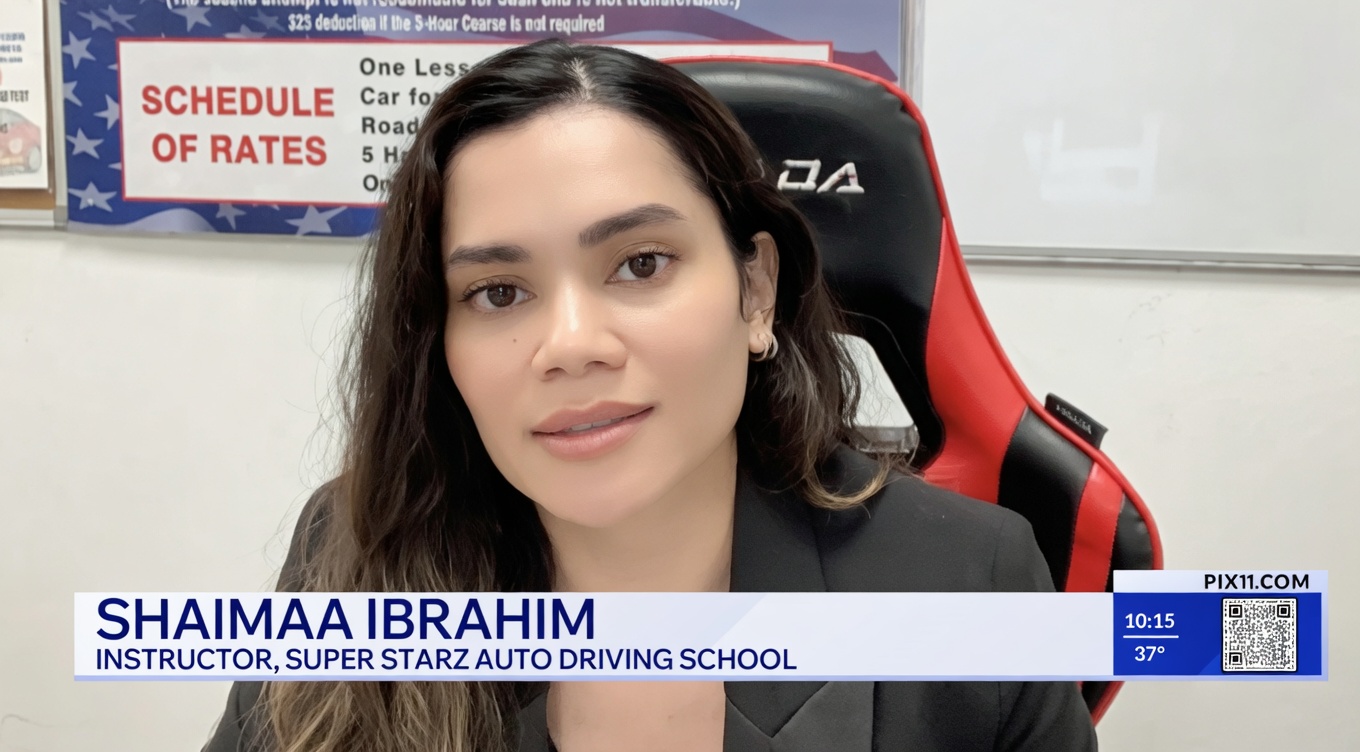
Every spring, we lose an hour of sleep, and the consequences on the road are far more dangerous than most people realize. As a driving instructor at Super Starz Auto Driving School, I see it every year: the Monday after we spring forward, students are visibly groggier, their reaction times slower, and their judgment just a half-beat off. In New York City, a half-beat is all it takes.
Daylight Saving Time Raises Concerns of Drowsy Driving
In this segment, I sat down with PIX11 to talk about why the spring time change is especially dangerous for drivers — and shared the warning signs and safety strategies I teach every student at Super Starz Auto.
Watch the Full Segment on PIX11The Numbers Don't Lie: DST and Fatal Crash Spikes
A peer-reviewed study published by researchers at the University of Colorado Boulder found that fatal car crashes increase by approximately 6% during the week following the spring daylight saving time transition. That spike translates to roughly 28 additional fatal crashes across the country in just one week — all linked to a single lost hour of sleep.
The AAA Foundation for Traffic Safety and the Governors Highway Safety Association (GHSA) have both sounded the alarm on drowsy driving for years, and their findings are sobering. Research from these organizations estimates that drowsy driving is a factor in an average of 328,000 crashes annually — including 109,000 that result in injuries and more than 6,400 that are fatal. Perhaps most alarming: AAA's research indicates that drowsy driving fatalities are underreported by a factor of roughly 10 — and a separate AAA naturalistic driving study found that drowsy driving involvement in all crashes is nearly eight times higher than federal estimates indicate, meaning official police reports capture only a fraction of the real toll.
How Sleep Loss Multiplies Your Crash Risk
The AAA Foundation for Traffic Safety conducted a landmark study quantifying exactly how much your crash risk increases with every hour of lost sleep. These are the crash-rate multipliers compared to drivers who got seven or more hours of sleep:
- 6 to 7 hours of sleep: 1.3x the crash rate
- 5 to 6 hours of sleep: 1.9x the crash rate
- 4 to 5 hours of sleep: 4.3x the crash rate — more than quadrupled
- Less than 4 hours of sleep: 11.5x the crash rate — comparable to driving drunk
Read that last one again: getting fewer than four hours of sleep puts you at essentially the same impairment level as a driver with a blood alcohol concentration at or above the legal limit. The National Highway Traffic Safety Administration (NHTSA) and the National Safety Council have both confirmed that drowsiness slows reaction time, impairs judgment, and reduces a driver's ability to pay attention — effects that mirror alcohol impairment almost identically.
The National Sleep Foundation recommends that adults get 7 to 9 hours of sleep for safe daily functioning. During the DST transition, most Americans are already sleep-deprived by one hour, and for those who were already cutting it close, that single hour can push them into genuinely dangerous territory.
New York's Drowsy Driving Problem
Here in New York, the numbers are sobering. According to data from the New York Traffic Safety Statistical Repository, which draws on crash reports compiled by the Institute for Traffic Safety Management and Research (ITSMR), New York State recorded more than 14,000 fatigue-related crashes between 2021 and 2025 — roughly 3,000 to 5,000 police-reported crashes per year in our state alone, tied to drivers who were simply too tired to be behind the wheel. And because drowsy driving is notoriously difficult to detect after the fact, experts widely agree the true annual toll is significantly higher than what appears in police reports.
The Governors Highway Safety Association (GHSA) notes that drowsy driving is especially prevalent during two windows: late night/early morning hours (midnight to 6 a.m.) and mid-afternoon (2 p.m. to 4 p.m.) — times when our circadian rhythm naturally dips. During the DST transition, that early-morning danger window becomes even more pronounced because drivers are commuting in darker conditions on less sleep.
Why NYC Is Uniquely Unforgiving When You're Fatigued
I've taught driving lessons across Brooklyn and Staten Island for years, and I can tell you this: New York City driving demands your absolute best at all times. There is no coasting here. You can't zone out for five seconds on the BQE without the traffic pattern changing completely. You can't drift on the Belt Parkway where merges come fast and sight lines are short. And you definitely can't afford a delayed reaction on any Brooklyn street where pedestrians step off the curb mid-block — because they do, constantly.
After DST, the mornings are darker again. That means your 7 a.m. commute suddenly looks and feels like 6 a.m. Your body hasn't adjusted. You're navigating school zones where kids are harder to spot, sharing the road with cyclists in the bike lanes, and managing turns at intersections crowded with other drivers who are equally groggy. In a city with 8 million pedestrians, the margin for drowsy error isn't small — it's zero.
Warning Signs You're Too Tired to Drive
One of the biggest problems with drowsy driving is that fatigued drivers often don't realize how impaired they are until it's too late. Based on guidance from NHTSA, the National Safety Council, and the National Sleep Foundation, here are the warning signs to watch for:
Warning Signs of Drowsy Driving
- Frequent yawning or difficulty keeping your eyes open
- Drifting from your lane or hitting rumble strips
- Difficulty remembering the last few miles driven
- Missing exits or traffic signs you normally notice
- Tailgating without realizing it — reduced following distance
- Feeling restless, irritable, or unusually impatient
- Head nodding or "microsleeps" (brief, involuntary sleep episodes)
- Delayed reactions to braking vehicles ahead of you
If you recognize even one or two of these signs in yourself, you are already impaired. NHTSA is direct about this: the only true remedy for drowsiness is sleep. Coffee, loud music, and open windows are not real solutions — they provide a temporary boost that can actually make things worse by giving you false confidence.
9 Safety Tips to Beat Drowsy Driving During DST (and Beyond)
Drawing on recommendations from the AAA Foundation, NHTSA, the National Safety Council, the National Sleep Foundation, and the GHSA, here's what I tell every one of my students — and what I shared on PIX11:
Your Drowsy Driving Safety Checklist
- Start adjusting your sleep schedule early. In the days leading up to DST, go to bed 15-20 minutes earlier each night. The National Sleep Foundation recommends this gradual shift so your body clock has time to adapt before the change hits. (National Sleep Foundation)
- Prioritize 7+ hours of sleep, especially the week after the switch. AAA's crash-rate data is clear — anything below seven hours and your risk begins climbing. Below five hours, it more than quadruples. Make sleep non-negotiable during the transition. (AAA Foundation)
- Know your high-risk windows and plan around them. The GHSA identifies midnight-to-6 a.m. and 2-to-4 p.m. as peak drowsy driving periods. If possible, avoid driving during these windows in the first week after DST — especially the early-morning commute when it's now darker. (GHSA)
- Use the buddy system on long drives. The National Safety Council recommends having a passenger who can share driving duties and watch for signs of fatigue. On NYC highways like the BQE and Belt Parkway, even a 30-minute stretch can become dangerous if you're running on empty. (National Safety Council)
- Pull over if you feel drowsy — period. NHTSA is unequivocal: if you're feeling sleepy behind the wheel, pull over to a safe location and take a short nap (15-20 minutes). This is not optional advice — it's a safety directive. A rest stop or well-lit parking lot is always better than pushing through. (NHTSA)
- Don't rely on "tricks" to stay awake. Rolling down the window, blasting the radio, or drinking coffee are not substitutes for sleep. AAA research shows these measures provide only a brief, unreliable alertness boost. The only real countermeasure for drowsiness is sleep itself. (AAA Foundation)
- Watch for medication side effects. Many over-the-counter allergy medications, cold medicines, and prescription drugs list drowsiness as a side effect. NHTSA recommends checking all medication labels before driving, especially during spring allergy season when many New Yorkers are starting antihistamines. (NHTSA)
- Be extra vigilant as a new or young driver. The GHSA reports that drivers under 25 are disproportionately involved in drowsy driving crashes. I see this in my own students — younger drivers are more likely to stay up late and less experienced at recognizing fatigue behind the wheel. If you're a newer driver, build extra sleep margin into your routine. (GHSA)
- Advocate for your passengers' safety too. The National Safety Council encourages passengers to speak up if the driver seems drowsy. In my lessons, I teach students that calling out a tired driver is not rude — it's responsible. And if you're the driver and someone says you look tired, listen to them. (National Safety Council)
What I Tell My Students
When I'm in the car with a student at Super Starz, I don't just cover parallel parking and how to pass the road test. I teach them that their fitness to drive starts before they ever turn the key. Being a safe driver means recognizing when you're not at your best — and having the discipline to make the smart choice, even when it's inconvenient.
Daylight saving time is a yearly reminder that the small things matter. One hour of lost sleep. One moment of inattention. One split second of delayed braking. On roads as busy and unpredictable as New York's, that's all it takes.
So as the clocks spring forward, I'm asking every driver — my students and everyone else — to take drowsy driving seriously. Get your rest, know the warning signs, and if you're too tired to drive, just don't. Your life and the lives of everyone around you are worth more than getting there on time.
Sources & Further Reading
- AAA Foundation for Traffic Safety — Acute Sleep Deprivation and Risk of Motor Vehicle Crash Involvement
- University of Colorado Boulder — Spring Forward at Your Own Risk: Daylight Saving Time and Fatal Vehicle Crashes (peer-reviewed, Current Biology)
- National Highway Traffic Safety Administration (NHTSA) — Drowsy Driving
- NYS Traffic Safety Statistical Repository (ITSMR / University at Albany) — New York fatigue crash statistics (2021–2025)
- Governors Highway Safety Association (GHSA) — Wake Up Call: Understanding Drowsy Driving and What States Can Do (328,000 annual crashes estimate)
- Governors Highway Safety Association (GHSA) — Wake Up Call: Understanding Drowsy Driving and What States Can Do
- National Sleep Foundation — Sleep duration recommendations and DST adjustment guidance
- National Safety Council — Fatigue in the Workplace and on the Road